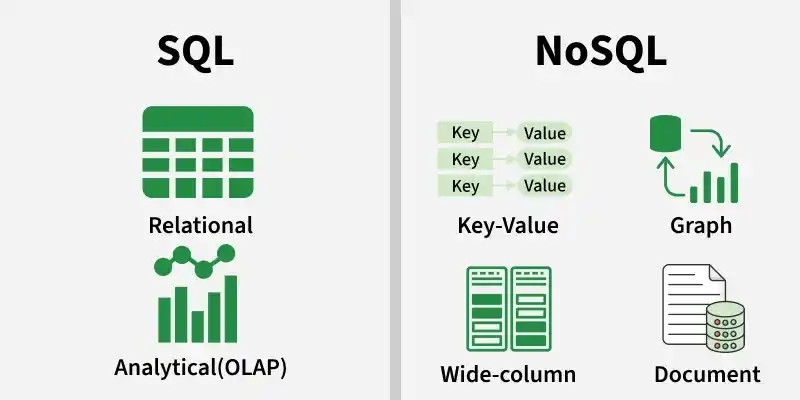
SQL vs. NoSQL: How to Choose the Perfect Database for Your Project
Every great application starts with a single, high-stakes question: Where are we going to store the data?
Choosing a database isn't just a technical box to check; it dictates how fast your team can build, how smoothly your app can scale, and how much your cloud bill will cost at the end of the month.
The tech world loves a good rivalry, and the debate between SQL (Relational) and NoSQL (Non-Relational) databases is as classic as it gets. But here is the secret: there is no single "best" database. There is only the database that matches your specific data structure and scaling needs.
Let's break down the core differences so you can confidently pick the right tool for your build.
1. The Case for SQL: Structure, Safety, and Relationships
SQL (Structured Query Language) databases are the veterans of the tech world. They organize data into strict, predefined tables with rows and columns—very much like a collection of highly organized spreadsheets that talk to each other.
If you are building a system where data accuracy is non-negotiable—like a banking application, an e-commerce checkout flow, or an inventory manager—SQL is your default choice.
Why you’ll love SQL:
ACID Compliance: This is the gold standard for data integrity. It guarantees that every database transaction is Atomic, Consistent, Isolated, and Durable. If a user buys a product, the inventory drops and the payment processes together, or the whole action rolls back. No partial, glitched data states.
Powerful Queries: SQL allows you to perform highly complex data analysis and deep "JOIN" operations across multiple tables using a standardized language.
Predictability: Because the schema (the blueprint of your data) is rigid, you always know exactly what form your data will take.
Popular SQL choices: PostgreSQL, MySQL, SQLite, Microsoft SQL Server.
2. The Case for NoSQL: Speed, Flexibility, and Massive Scale
NoSQL (Not Only SQL) emerged to handle the massive volumes of unstructured data generated by modern web applications. Instead of strict tables, NoSQL databases utilize flexible models like Documents (JSON), Key-Value pairs, Column families, or Graphs.
If you are building a real-time analytics dashboard, a content management system, a social media feed, or a messaging app where the data structure changes constantly, NoSQL is built for the job.
Why you’ll love NoSQL:
Dynamic Schemas: You can save a data record today with three fields, and save a completely different one tomorrow with ten fields—all in the same collection. No migrations required.
Horizontal Scaling: While SQL scales vertically (buying a bigger, more expensive server), NoSQL scales horizontally (adding more cheap servers to form a cluster). This makes it incredibly efficient at handling petabytes of data and massive traffic spikes.
Developer Velocity: Because data is often stored in JSON documents, it maps beautifully to modern Javascript/Typescript codebases, speeding up early-stage development.
Popular NoSQL choices: MongoDB (Document), Redis (Key-Value), Cassandra (Columnar), Neo4j (Graph).
The Ultimate Decision Matrix
When you are staring at a blank architecture diagram, use this quick reference table to align your project goals with the right database paradigm:
FeatureSQL (Relational)NoSQL (Non-Relational)Data StructureStrict, structured, table-basedFlexible, dynamic, document/key-valuePrimary StrengthUnmatched data integrity & complex relationshipsRapid development & massive volumeScaling ModelVertical (Scale up CPU/RAM)Horizontal (Scale out across machines)TransactionsStrict ACID guaranteesEventual consistency (usually)Best Used ForFinance, ERPs, SaaS core systems, e-commerceIoT, real-time analytics, user profiles, feeds
The Golden Rules for Making Your Choice
To lock in your choice, ask your team these three diagnostic questions:
How connected is your data? If your app relies heavily on relationships (e.g., "Find all users who bought product X, live in city Y, and follow user Z"), go with SQL. NoSQL struggles with deep relational joins.
Is your data structure predictable? If you know your data types won't change much over the next two years, pick SQL. If you are iterating rapidly on an MVP and the data model changes daily, pick NoSQL.
What are your scaling realities? If your app needs to handle millions of read/write requests per second from day one (like an IoT sensor grid), NoSQL handles that level of distributed scale out of the box.
The Modern Alternative: Polyglot Persistence
You don't always have to choose just one! Most modern engineering teams use a hybrid approach. They might use PostgreSQL to securely process user accounts and financial transactions, while utilizing Redis for super-fast session caching, and MongoDB to handle a flexible product catalog.
Align your database with the shape of your data, and your application will naturally follow a path to success.